
ALLENTOWN, Pa. — Lehigh County Executive Josh Siegel used his inaugural State of the County address Thursday evening to announce plans to declare homelessness a disaster and emergency, explore a 1% local option sales tax and introduce legislation barring county cooperation with federal immigration enforcement.
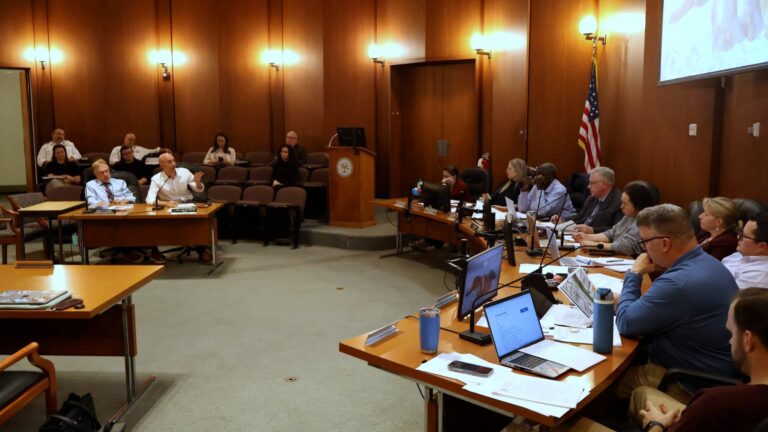
Speaking before a packed house at the PNC Club Level at Coca-Cola Park, Siegel — the youngest county executive in Pennsylvania history — outlined proposals spanning housing, fiscal policy, tourism, worker benefits and the county’s response to the Trump administration.
“The time for half steps and half measures is over,” Siegel said during the roughly hour-long address, hosted by the Greater Lehigh Valley Chamber of Commerce.
In a post-speech interview, Siegel said the immediate priorities are signing the homelessness executive order and getting what he called “resistance legislation” before the Board of Commissioners.
“We want to show that we can not repeat the sins of the past, not make the mistakes of leaders who held office before us,” Siegel said. “This is all about getting it right.”
Finances: ‘No cupboards left to raid’
Siegel opened with the county’s finances, telling the crowd that Lehigh County has run a structural deficit every year since 2021, except 2024, when one-time American Rescue Plan funding covered the shortfall.
The county’s fund balance has dropped from over $40 million to $28.7 million, he said, and the projected annual deficit is expected to reach $5 million by 2027.
“There are no cupboards left to raid or seat cushions to shake,” he said.
His largest fiscal proposal is a push to study a 1% local option sales tax, modeled after the regional asset district in Allegheny County — the only county outside Philadelphia currently authorized by the state to levy such a tax.
Siegel said his administration is working with the Pennsylvania Economy League to assess potential revenue, with the goal of tying new dollars to senior property tax relief, housing, homelessness, mental health and public transportation.
Currently, Pennsylvania law does not grant Lehigh County the authority to impose a local sales tax. Any such measure would require approval from the General Assembly in Harrisburg. Siegel did not address that hurdle in his remarks.
He noted that counties across the political spectrum, including Republican-leaning York and Lancaster and Democratic-leaning Montgomery and Delaware, have raised revenue in the past year.
“Let us not engage in the abstract alternatives that simply say we can magically balance our expenses with undefined savings,” Siegel said. “Decreasing our expenses can only be achieved by balancing our budget on their backs. That means cutting services, reducing staff and undermining our mission.”
Commissioner Ron Beitler this week criticized Siegel’s proposal to cut unfilled positions at the county-run Cedarbrook senior care facility and the county jail to fund new communications and administrative staff in the executive’s office.
Siegel did not address the dispute in his speech.
Housing: Buying vs. building
On housing, Siegel announced that the county is working with consulting firm Baker Tilly on an asset-acquisition model to purchase existing multifamily housing rather than relying solely on new construction.
He cited the Philadelphia Housing Authority as a model, saying it acquired 1,500 units in 18 months at a fraction of the cost of new construction.
PHA has acquired 1,515 units for $280.6 million since early 2025, according to the Philadelphia Inquirer, and plans to acquire 4,000 over two years.
“Lehigh County can be at the forefront of fighting off private equity and price-gouging national real estate trusts to exploit our residents for profit and greed,” Siegel said.
He described himself as a “proud YIMBY” — yes in my backyard — and called on the county’s 25 municipalities to embrace denser development, repurpose underused shopping plazas and office parks, and build more “missing middle housing” such as duplexes, triplexes and quads.
Homelessness: Executive order, vacant facility
Siegel said he would sign an executive order in the coming days to officially declare homelessness a disaster and emergency and to direct his cabinet to develop a long-term strategic plan for transitional housing, including identifying county land for a potential tiny home community.
“The era of bulldozed encampments and reactionary responses to our homeless residents must end,” he said.
He pointed to the county’s Community Corrections Center, a 400-bed facility that has sat vacant since COVID. Siegel said the facility alone could “functionally eliminate homelessness in this county, in this region,” citing similar jail-to-shelter conversions in Albany County, New York, and King County, Washington.
The 2024 point-in-time count found a 91% increase in unsheltered homelessness in the Lehigh Valley over the prior year. In 2023, approximately 686 people in 465 households were counted as unsheltered across Lehigh and Northampton counties.
The 2022 count found nearly 1,000 people experiencing homelessness overall. Results from the January 2025 count have not been publicly released.
In the post-speech interview, Siegel acknowledged that the challenge is broader than one county can solve.
He said the three Lehigh Valley cities, Allentown, Bethlehem and Easton, do well with short-term crisis response during emergencies like snowstorms, but that a long-term housing pipeline is what’s missing.
Siegel said what’s missing is a long-term plan. “What do we do to house people and how do we get them on a pathway to stability?” he said.
He said the county should explore a designated encampment site, similar to one in Dauphin County, where a nonprofit, with county grant funding, purchased a $670,000 lot near Harrisburg’s existing encampment and created a sanctioned space with services.
Without a long-term solution, he said, the cycle of bulldozing camps and displacing people continues.
He also called for the creation of a strategic homeless coordinator position within the Department of Community and Economic Development, and said he hopes to eventually expand the effort into a bi-county initiative with Northampton County.
ICE: Office vacated, database planned
Siegel used the speech to announce plans to introduce legislation codifying non-cooperation with U.S. Immigration and Customs Enforcement, barring county employees from participating in the federal 287(g) program.
He also said the county would explore creating a database where residents could upload videos and reports of ICE enforcement operations.
In the interview, Siegel said the database concept is modeled after a similar effort in New Jersey. The idea, he said, is to create a repository for documentation in case of a future congressional investigation into federal enforcement actions.
“If ICE were to come here in a serious fashion and be conducting unlawful, unconstitutional raids or engaging in an excessive use of force, we want a place where folks who are exercising their First Amendment rights … to be able to upload that data and upload those videos so we can hold onto them,” Siegel said.
He said the county could build the system internally without hiring a contractor.
Siegel also confirmed that the ICE investigative unit that had been occupying a county-owned building, the subject of a January dispute over more than $115,000 in unpaid rent, vacated the office this week. He said the agency has agreed to pay the back rent.
“That chapter is closed,” Siegel said.

Federal pushback
Beyond immigration, Siegel said he would create a rapid-response task force with United Way to help residents maintain healthcare coverage amid anticipated Medicaid and SNAP cuts.
He also called for a medical debt relief fund, citing a local effort in which five Episcopal churches and one Lutheran church raised $25,000 and used the debt-buying market, through the organization Undue Medical Debt, to forgive $3.2 million in medical debt for more than 2,300 people across Lehigh, Northampton and Monroe counties in January 2025.
He promised to protect election integrity locally and pledged that the county would work to fill gaps created by federal cuts to reproductive healthcare and food assistance.
“I think appeasement only inspires the next Minneapolis,” Siegel said, referencing recent ICE enforcement operations in that city. “Capitulation only encourages more overreach.”
Tourism and ‘staycations’
Siegel called for the establishment of a tourism improvement district, or TID, which he estimated could raise $7.5 million annually and generate $23 million in local spending and tens of thousands of new hotel stays.
He asked commissioners to begin the process by establishing a framework that would compel hoteliers to form a coalition before formally assessing any fee.
He also announced a “Staycation in Lehigh County” campaign in partnership with Discover Lehigh Valley, encouraging residents to vacation locally.
Paid leave and workers
Siegel proposed creating a voluntary, paid family and medical leave fund in partnership with United Way, funded through payroll deductions from participating employers.
He said the county is working with the Urban Institute to model different participation and benefit structures.
He also announced plans to introduce legislation offering eight weeks of paid family leave to county employees, which he called one of the most generous municipal-level policies in the commonwealth.
“Let’s build a Lehigh Valley where workers do not have to choose between caring for their newborn or getting the medical care they need and paying the rent,” Siegel said.
Other proposals
Siegel also called for making the Redevelopment Authority’s executive director a full-time position, retooling the county’s Office of Community and Economic Development to provide grant-writing assistance to smaller municipalities, and modernizing county communications and the county website.
He spoke favorably of the Neighborhood Improvement Zone, Allentown’s signature economic development tool, but said in the post-speech interview that critics raise valid concerns about priorities.
“I think the criticisms of the NIZ are more about where our priorities lie,” Siegel said. “Have we been too focused on development for the haves and more of a market-rate approach? … Their frustrations are genuine. We can revitalize downtown Allentown and focus on homelessness and housing. It’s a false dichotomy.”