
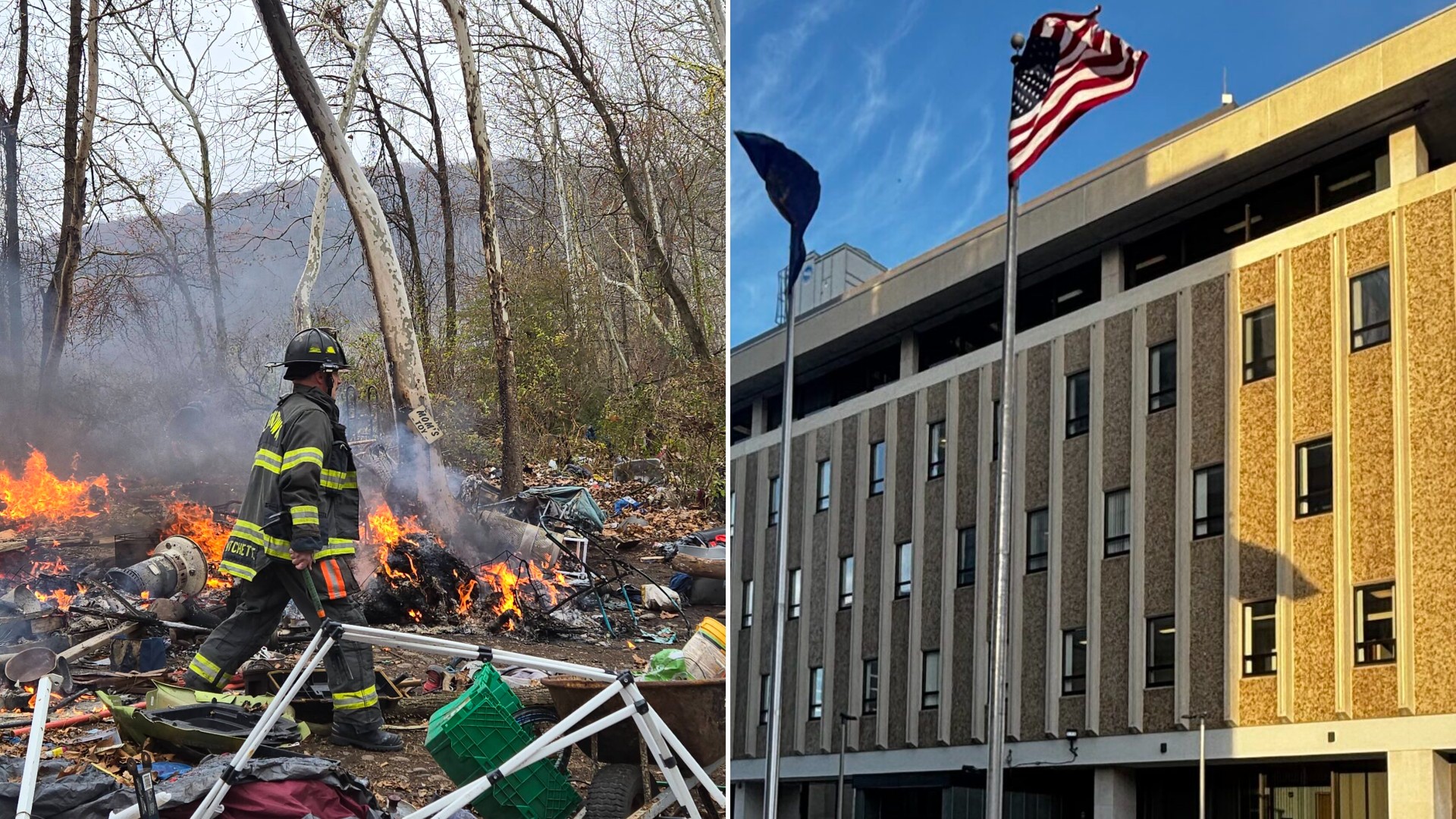
ALLENTOWN, Pa. — Allentown would have to post at least 30 days’ written notice before clearing a homeless encampment from city-owned property unless it poses an immediate danger, under Bill 66, which City Council’s Community and Economic Development Committee will consider Wednesday at 6 p.m. in Council Chambers at City Hall.
The bill, sponsored by Councilwomen Ce-Ce Gerlach and Natalie Santos and filed Sept. 30, would add Chapter 130 to the city code. It is the third version of clearing rules the council has considered in a year, and it gives residents less time than the first.
No city ordinance now sets how the city clears encampments or how much notice residents get. When the city posted notices at a Jordan Creek camp on Aug. 7, 2025, residents were given until Aug. 25 to leave, or 18 days.
Under Bill 66, an encampment is a grouping of five or more tents, tarps or temporary shelters where people are living. The definition does not cover smaller groupings.
If the bill passes, before the city clears any encampment that is not an emergency, it would have to make reasonable efforts to conduct outreach, identify available shelter and housing, coordinate with service providers and give information about services.
The city would also have to post at least 30 days’ written notice before removal in two cases: an encampment in a high-risk location, and one on other city-owned property where a joint decision finds removal is warranted.
Notice would be posted at the site in English, Spanish and any other language known to be spoken in the encampment, with a date by which people must leave and information about housing, shelter, health, behavioral-health and substance-use services.
That 30-day period is one-third of the 90 days’ written notice in Gerlach and Santos’ first version, Bill 83, introduced Oct. 15, 2025. Bill 83 would also have required the city to meet with the Commission on Homelessness at least 60 business days before posting notice, and to run a community response line, train city employees and keep a shared encampment database, none of which Bill 66 states.
The city could remove an encampment that poses an immediate danger without 30 days’ notice. The bill lists an active fire, active violence and imminent flooding as examples, and the managing director or a designee would decide whether an emergency hazard exists.
For other city-owned property, removal would be decided jointly by the managing director, the council president or a designee and a representative of service organizations. If they find no sufficient threat, the city would monitor the site and continue outreach.
The bill says the city will maintain a written risk-assessment rubric with objective criteria for removal. It says an encampment scoring more than 20 points under the rubric is subject to posting and the evacuation process.
Camping in city parks would remain prohibited. Law enforcement could direct anyone who returns to an area cleared and posted as an emergency-hazard or high-risk location to vacate, subject to applicable law.
Before removal, people could take their belongings and clean up minor conditions. Afterward, the city could remove abandoned property and debris, and would retain identification found on site. The bill states no storage period for other property and no penalty for violating the procedures.
The administration would report to council every two weeks on encampments addressed, notice given, services offered and emergency removals.
In a Feb. 2 video about an earlier version of the bill, Gerlach said the city had no standard operating procedures for closures.
“I do not support bulldozing people’s homes, period,” Gerlach said. “No consistent notice, no clear expectations for staff or residents, no single number to call when someone’s worried about an unsheltered neighbor.”
“Housing is the solution,” Gerlach said. “Until we get there, we must govern with humanity.”
Gerlach said in the video that she changed parts of the policy based on feedback from council, the Homeless Law Center and the Commission on Homelessness. Neither Gerlach nor Santos had posted about Bill 66 itself on the accounts searched for this story as of Tuesday.
The proposal follows a year of clearings along Jordan Creek. City crews cleared three camps there last fall, and residents said more than 100 people lived at the Jordan Creek camp on some days, according to Lehigh Valley Public Media.
If the committee advances Bill 66 on Wednesday, it would go to the full council. The ordinance would take effect 10 days after final passage.
The same committee will also consider Bill 67, a $500,000 state pass-through grant to support Ripple Community Inc. The committee will meet at 435 Hamilton St., and Legistar lists video and an eComment portal for the meeting.