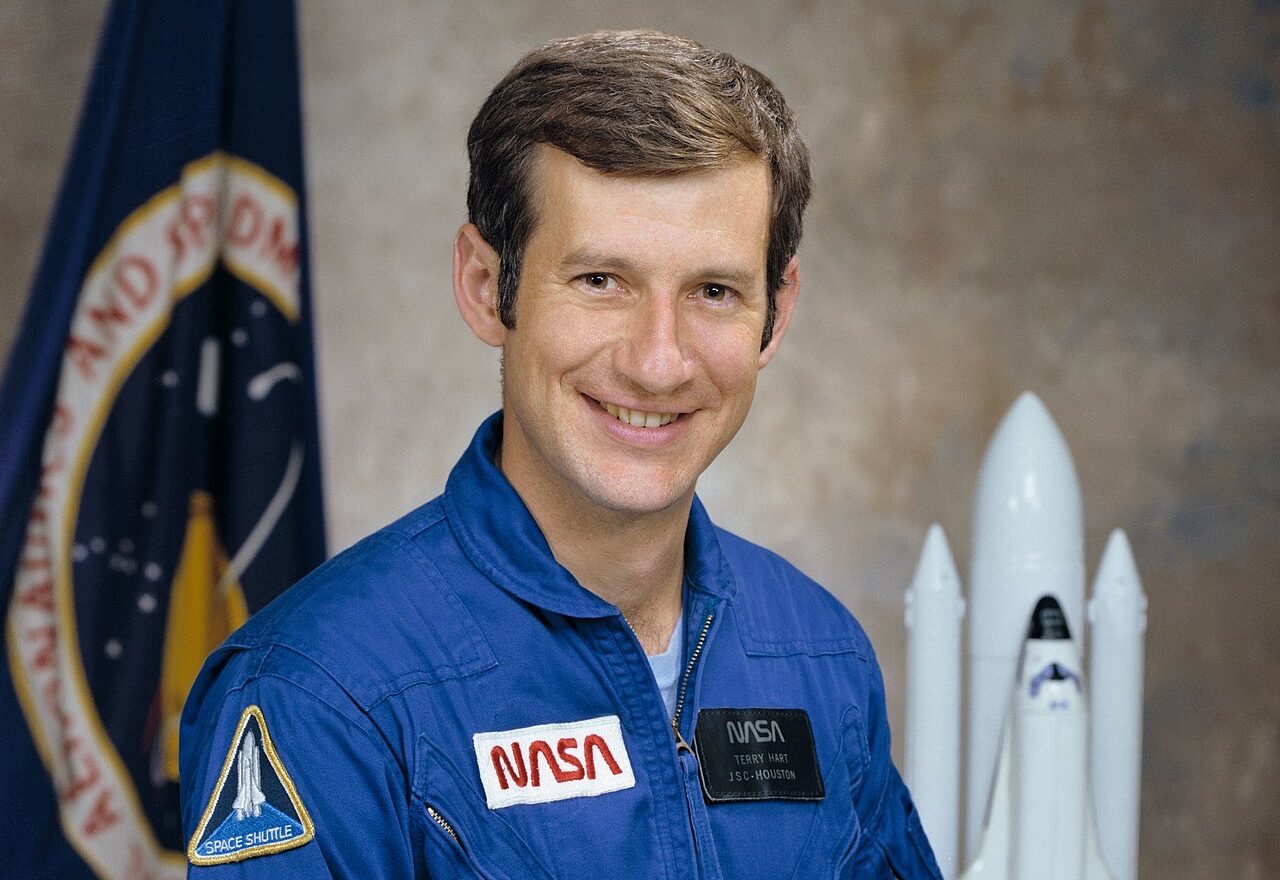
For former NASA astronaut and current Lehigh University Mechanical Engineering & Mechanics professor Terry Hart, the Artemis II mission is just one small step in space exploration. Professor Hart was a mission specialist on NASA’s STS-41-C Challenger mission that launched in 1984 and spent a week in orbit.
“We’re picking up where we left off,” Hart said about Artemis II. “And so it’s a whole new effort to go back in a more permanent way, rather than just a little bit of science and then come back.”
Four astronauts – Victor Glover, Christina Koch, Reid Wiseman, and the Canadian Jeremy Hansen – splashed down at 8:07 p.m. on Friday, April 10, 2026, off the San Diego coast after a 9-day trip around the moon.
On the sixth day of their flight, they broke Apollo 13’s record for the longest distance humans have been from Earth, at 252,756 miles. However, while Neil Armstrong, Buzz Aldrin, and Apollo 11’s race to the moon was spurred by Cold War tensions, Hart said that America now has broader goals.
“We’re going to be conducting construction of facilities on the South Pole, where there’s a fair amount of ice, the scientists think,” Hart said. “So we can use that water and actually make rocket fuel out of it and all those good things.”
Hart didn’t deny, though, that NASA’s goals have also expanded beyond science.
“There’s a commercial part to it, too, now,” he said. “We’re learning how to live on the space station, and there are companies now – venture capitalists – that are looking for opportunities in space and doing the other things in space that are of commercial value.”
With advancements in technology and in America as a country, the moon and outer space have suddenly become very real prospects. Hart recalled meeting Walter Cronkite after the famous broadcaster had decided to narrate The Dream is Alive, a 1985 IMAX documentary film that centered on Hart’s Challenger mission.

“They don’t show it on IMAX theaters anymore,” Hart joked. He noted that people could watch the 40-minute film on YouTube. “But that’s as close as you can get to visually being there. It’s not quite the same, but it’s almost as good.”
NASA recently released photographs taken by the Artemis II astronauts during their lunar flyby, which awed Americans. The photos show how much American technology has grown since astronaut William “Bill” Anders took his iconic Earthrise photo in 1968. During that year, Hart was a senior at Lehigh studying mechanical engineering, watching the Apollo 8 mission on TV.
“It was Christmas Eve,” he said. “They went around the moon three times, and came back before something broke. But they were so focused on the moon, because they were trying to take photographs for the upcoming landings, that no one ever thought of taking a picture of the Earth.”
He described how, as the astronauts began their descent, they saw Earth rise over the horizon. He held up an imaginary camera, referencing how Anders saw the sight out his window, grabbed a “70-millimeter square format big picture camera,” a Hasselblad, and snapped the now-iconic photo.
But he said that photos can’t exactly capture the feeling of no-gravity.
“The biggest difference is being weightless,” Hart said. “You can’t simulate that on earth, right? We’re trapped here with gravity. That feeling is really special, and only the astronauts can enjoy that.”
Hart, though, reflected on seeing the Earth from a different perspective.
“When we get out into space and look back at Earth, either scientifically or just look at it philosophically, we put things in a better perspective, in terms of taking care of the planet but also taking care of each other,” he said. “200 years from now, maybe historians will say the best thing that came out of the space program was that sense of oneness that we all need to have to take care of this planet and each other.”
Astronaut Victor Glover, one of the four astronauts on Artemis II, recently echoed that sentiment during an interview from space with CBS News.
“Trust us, you look amazing, you look beautiful,” Glover said. “And from here, you also look like one thing – homo sapiens is all of us. You guys are on a spaceship called Earth that was created to give us a place to live. This is an opportunity for us to remember where we are, who we are, and that we are the same thing.”
Bill Anders said something similar in 1968 after returning from Apollo 8: “We set out to explore the moon, and instead discovered the earth.”
Space exploration has always seemed to be a unifying force for the country and the world at large. America raced to land on the moon amid Cold War tensions with the Soviet Union and a number of domestic problems.
“It’s a little bit of déjà vu going on for me,” Hart said. “When I graduated in ‘68, the country was in a pretty bad way.” He cited various issues afflicting the country at the time: the Vietnam War, the assassinations of Dr. Martin Luther King Jr. and Robert F. Kennedy, race riots, fires in Los Angeles, and a “bloodbath” at the Democratic National Convention in Chicago.
“The country really was in a pretty bad way, but the lunar program, everyone could kind of get together to celebrate that, and I kind of feel history is rhyming again,” he said. “The country is going through a lot of struggles here with division and chaos and cruelty that’s, frankly, surprising, yet we can all feel kind of good about these four people going behind the moon and coming back safely.”
He said space exploration was more than a feel-good story, though.
“This country of ours, we’re amazing, there’s so much we can do for the world if we put our mind to it in a positive way, but we keep seeming to get in our own way with differences that are really not very important, yet some people seem to make them important for the wrong reasons,” he said. “Without getting too political, in a sense, the space program does help us see what we can really be if we choose to do that.”
There will always be critics or people who question the importance of exploring space. In 1963, former President Dwight D. Eisenhower called President John F. Kennedy’s race to the moon “nuts.”
Between 1960 and 1973, America spent $25.8 billion, or approximately $309 billion in today’s money, on Project Apollo – almost four percent of the federal budget. Now, NASA takes about one percent.
“It’s a lot of money, but in the grand scheme of things… these programs are small compared to the DOD (Department of Defense) budget,” Hart said. “In fact, in the 1960s, those three programs that led to the moon landings, we spent about the same amount of money on dog food.”
Where President Kennedy went against the grain to invest billions in the space race, despite the objective or even probability of success seeming unclear, today’s administration has different ideas.
Early in President Donald Trump’s second administration, he proposed an ultimately rejected 24-percent cut to NASA’s budget, which would have reduced it to $18.8 billion. And just last Friday, he proposed a budget that would cut NASA’s funding by 23 percent.
However, President Trump has also proposed billions in funding increases, and the president recently went live to call the four astronauts in space, saying he’d decided to invest in NASA.
“You know, I had a decision to make in my first term, and the decision is: what are we going to do with NASA?” President Trump said. “And I had very little hesitation. And it’s really great to have somebody like Jared involved, because it really makes it much easier for me. But it was not even a question in my own mind.”
The president was referencing NASA’s current administrator, Jared Isaacman, who gave a public lecture at Lehigh University in October 2025. Hart, who attended the lecture, expressed confidence in Isaacman’s ability to lead American space exploration through the 21st century.
“Jared Isaacman, I think he’s doing all the right things,” Hart said.
NASA now works with private companies to bolster its missions. Hart noted that a key aspect of the next mission to the moon will be the lunar landers, and that the aerospace companies SpaceX and Blue Origin are currently competing to design these landers.
“I’m not real comfortable with either one technically yet,” Hart said. “I think they have a long way to go to prove that they’re going to be reliable for going down to the surface of the moon and come back up again.”
When Isaacman visited Lehigh, he addressed concerns about the role of private enterprise in working with public agencies.
“When he was here last fall, the way he put it was excellent,” Hart said. “He said NASA needs to do the hard stuff; there’s no incentive for private industry to do that. These businesses kind of figure out the business model that would be profitable for them, with the government buying the rocket and building it themselves, which brings the cost down. And so NASA has to continually move on to the most challenging things, and then as business figures out how to do it more profitably, they come in behind NASA.”
He said profitability didn’t mean sacrificing safety. He noted NASA’s history of disasters in space, notably with life-threatening explosions on the Apollo 13 mission that later became immortalized in the 1995 Tom Hanks film of the same name, as well as the seven astronauts killed after the Space Shuttle Challenger broke apart 73 seconds into its flight in 1986.
Hart had spoken with two of the astronauts on that 1986 mission, Dick Scobee and Mike Smith, a day before they lifted off.
Hart cited the airline industry as a prime example.
“The airline industry is extremely safe. It’s really rare when we have a failure that kills people in the airline industry, and that’s because the airlines can’t stand to have those kinds of errors,” he said. “They know that hurts their business.”
He said safety and profitability can go together, but only if managed correctly.
“That’s the challenge, getting good managers that can understand how to manage risk and schedule money and all that,” he said. “That’s the challenge, but I think Jared Isaacman is spot on; he really understands where to take NASA right now.”
Where NASA ends up and what the space program ultimately achieves remain to be seen. Hart tempered expectations on regular people living on the moon.
“We can’t all go to the moon,” he said. “Eventually, maybe tourism, but I try to minimize that because I don’t think the typical tourist is going there in the next few decades.”
The engineering professor said space exploration is somehow bigger than visiting the moon or even going to Mars.
“A big piece of it [is] the sense of exploration, the passion it generates in young people, particularly to learn how to be good scientists and engineers, and then behind it comes the commercial aspects.”
In October 2025, Professor Hart helped kickstart a master’s degree program in Aerospace and Space Systems Engineering at Lehigh.

Since joining Lehigh’s faculty in 2004, Hart has helped his students advance their careers with organizations such as Blue Origin, Boeing, the Federal Aviation Administration, Lockheed Martin, NASA’s Jet Propulsion Laboratory, Northrop Grumman, and SpaceX, among others.
The former astronaut also stays active on social media at his profile @iHartAerospace, where he often answers questions about the astronaut experience.
He said it’s a privilege to have these opportunities.
“It’s a privilege to be in that position, where you get to fly on those missions, but it’s important to realize it’s a big team effort,” he said. “There’s always room for a genius to come along and invent things, but more and more as technology becomes more complex, you need teamwork and people of all different stripes that come together to do these hard things. As Kennedy said, we do these things because they are hard.”
He was referencing President Kennedy’s 1962 quote.
“We choose to go to the moon in this decade and do the other things, not because they are easy, but because they are hard,” President Kennedy famously said to students at Rice University in Houston, Texas. “Because that goal will serve to organize and measure the best of our energies and skills, because that challenge is one that we are willing to accept, one we are unwilling to postpone, and one we intend to win, and the others, too.”