
BETHLEHEM, Pa. — Leaders at Community Action Lehigh Valley are warning of devastating ripple effects as federal funding cuts begin to hit critical programs that serve more than 100,000 people across the region each month.
With shelves nearly bare at Second Harvest Food Bank and key housing and energy programs facing elimination, advocates said families, farmers, and middle-class workers could feel the consequences.
“This is just the beginning,” said Dawn Godshall, CEO of Community Action Lehigh Valley, during a press event Monday. “We need legislators to do the right thing. We need people to stand up and speak up.”
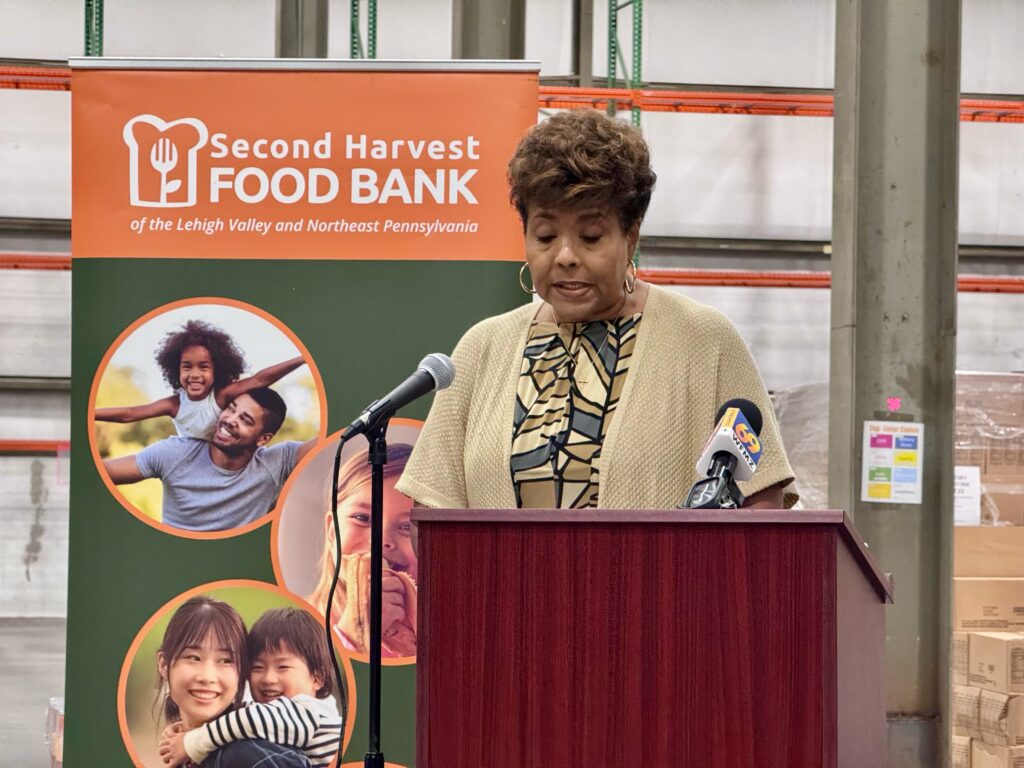
Second Harvest, which serves six counties in northeastern Pennsylvania, lost funding from the Local Food Purchase Assistance program. The program had supported about 40 local farms by purchasing their eggs, dairy, meat, and fresh produce, then distributing that food to 170 food pantries in the region.
“The ripple effect of these decisions will be felt throughout the remainder of the year and beyond,” Godshall said. “Members of our Pennsylvania communities will go hungry.”
Other looming cuts include the possible elimination of the Low Income Home Energy Assistance Program, or LIHEAP, and the Weatherization Assistance Program — funding that Community Action Chief Financial Officer Jessica Reimert said totals $2.6 million.
“That means no more heating system replacements in the dead of winter, no more roof repairs, no more help for homes that are on the brink of being uninhabitable,” Reimert said. “We hire local contractors to do the work. If these programs are cut, they and their employees will be out of work.”
Community Action currently receives $5.4 million in federal funds. That support includes $1.4 million from the Community Services Block Grant, which funds housing counseling, two community development subsidiaries, and the Sixth Street Shelter.
Last year, the agency’s housing counseling program helped prevent foreclosure for 47 families.
Reimert said cuts to the Emergency Food Assistance Program, or TEFAP, which provides Second Harvest with $9.5 million worth of USDA food annually, would further limit options for low-income residents.
“If these cuts go through, people laid off from food suppliers may show up at the food pantry only to find it’s not stocked,” she said. “Or they’ll turn to SNAP — which is also being cut.”
The so-called One Big Beautiful Bill Act, signed into law July 4, expanded work requirements for SNAP recipients up to age 64, mandating 80 hours of employment or training per month.
“Data shows that a reduction in benefits does not lead to self-sufficiency and improved economic outcomes,” Reimert said. “These cuts may look like savings on paper, but they do come at a cost — and that cost will eventually reach every one of us.”
At Second Harvest, staff are working urgently to respond with more efficient sourcing and deeper relationships with local partners.
“We live in a very food-rich area,” said Melissa Conway, operations manager for Second Harvest. “We’ve strengthened relationships with local warehouses and added another driver so we can pick up donations at will.”
The food bank recently received three truckloads from Wakefern Corporation, a new partner helping to offset the pending loss of donations from UNFI, which is closing this fall. UNFI donated 500,000 pounds of food last year.
To secure more fresh produce, the team is leveraging partnerships with nonprofits such as America’s Grow-a-Row and using Feeding America’s bidding system to bring in diverse food supplies.
“Our warehouse is struggling to keep food on the shelves because it goes out as fast as it comes in,” Godshall said. “The increased need has been met with decreased funding, and the impact is devastating.”
Godshall stressed that the stereotype of food pantry clients being unemployed or dependent is far from reality.
“Many have two or three incomes and still can’t make ends meet,” she said. “They are your neighbors, your children’s classmates, the person next to you in church. It’s embarrassing to work hard and not be able to adequately provide for your family.”
Community Action is urging the public to contact legislators, advocate for restored funding, and donate.
“Hunger and poverty don’t have a political party,” Godshall said. “We can’t expect things to get better until we as a society do better.”