ALLENTOWN — Republican Robert E. Smith Jr. laid out his case to voters in a community Zoom forum Sunday, addressing his priorities on taxes, immigration enforcement, homelessness and bilingual representation two days before a special election that could help determine control of the Pennsylvania House.s
Smith faces Democrat Ana Tiburcio on Tuesday in the race to fill the 22nd District seat vacated by Josh Siegel, who resigned in December after being elected Lehigh County executive.
The outcome is one of five special elections that could tip the balance of power in the state House, where Democrats hold a razor-thin 100-98 majority with five vacancies.
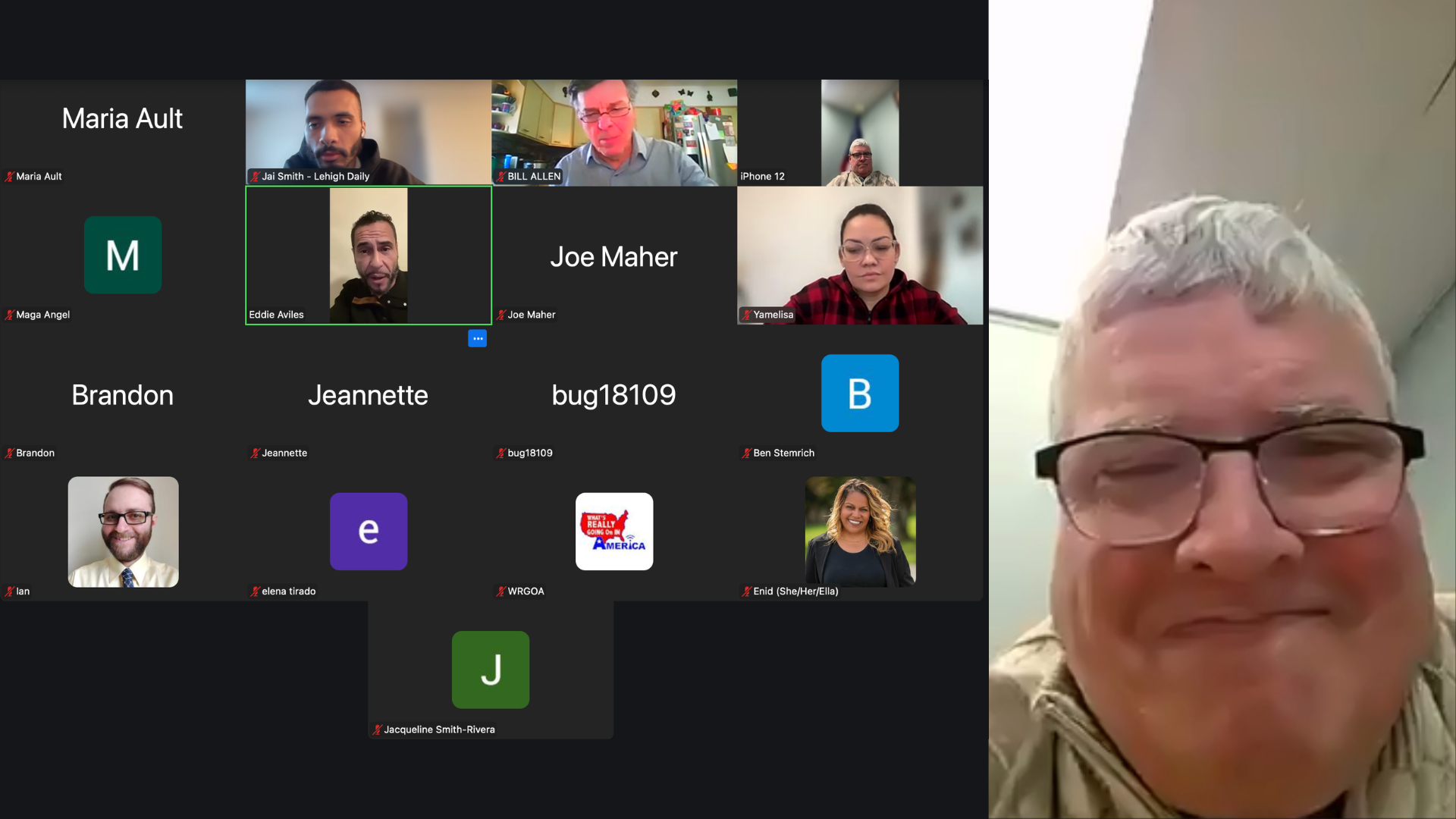
Smith spoke during ‘Community Connect,’ a roughly 90-minute forum moderated by Bill Allen, president of the Pennsylvania Integrity Network, and attended by community members, reporters and local figures, including Eddie Aviles, a member of the city’s homeless commission, and Yamelisa Taveras, a certified addiction counselor and CEO of Counseling Solutions of the Lehigh Valley.
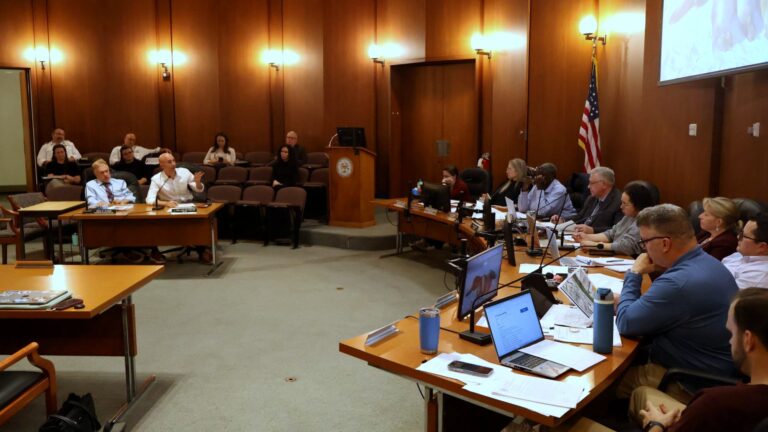
Tiburcio was not present at the forum and did not respond to a request for comment sent Sunday afternoon. Her positions referenced below are drawn from the candidates’ Feb. 12 televised debate at the Da Vinci Science Center, the only head-to-head meeting of the race.
The district, which covers parts of East Allentown, Center City and eastern Salisbury Township, is the poorest state House district in the Lehigh Valley, with 23.2% of residents living below the poverty line.
Approximately 62% of residents are Hispanic. Democrats outnumber Republicans in voter registration, though their margin has narrowed from nearly 70% in 2022 to 53% today.
Taxes, NIZ and the state hospital deal
Smith criticized a land deal involving the former Allentown State Hospital property — and tied it directly to his opponent.
“J.B. Reilly pays $5 million for 198 acres. And then the school district turns around and gives them $14 million for 16 acres,” Smith said, referring to the founder of City Center Investment Corp., a major developer in the NIZ. “They said it included infrastructure. Why does the school district have to pay for the infrastructure? That was terrible. A terrible deal. She voted for this.”
Smith was referring to Tiburcio’s vote as an Allentown School Board member. He also questioned $20 million in state funds used to demolish buildings on the property before it was sold to a single buyer, asking why the sale was not opened to competitive bidding.
On the Neighborhood Improvement Zone, Smith called for abolishing the NIZ and returning tax revenue to residents. He said he supports a bipartisan bill currently stalled in a House committee that would require a full accounting of NIZ finances.
“I don’t see what they’re doing for the public,” Smith said of the NIZ. “We got an arena, great. The arena is not open every day.”
In the Feb. 12 debate, Tiburcio took a more measured view. “In a way, the NIZ has benefited the district,” she said, citing the Da Vinci Science Center itself as NIZ-funded. But she acknowledged that rents in NIZ-developed buildings are “a little bit outrageous” and said affordable housing must be part of the conversation.
When asked about state Sen. Jarrett Coleman’s push for NIZ audits, Tiburcio said she did not have enough knowledge on the topic to answer.
More broadly, Smith called for tax relief across the board, including the elimination of the Allentown privilege tax, which he said discourages contractors and small businesses from working in the city.
Maria Ault, a community member on the call, said the tax has driven her husband’s construction business away from Allentown jobs.
Smith said he backs Gov. Josh Shapiro’s proposal to legalize recreational marijuana and regulate games of chance to generate revenue, a plan the governor’s office has estimated could bring in up to $2 billion, and said those funds could be used to offset property taxes.
“Why are the states around us getting all this money? Delaware, Maryland, Jersey — they’re getting all this tax money from Pennsylvanians,” Smith said. “Pennsylvanians are going over there and spending their money when they could be spending it right here.”
Tiburcio also supports legalizing recreational marijuana. In the debate, she pointed to the potential public safety benefits of regulated sales, saying legalization would reduce illegal distribution. Both candidates said regulation should mirror the state’s approach to alcohol.
He added that he would support allowing small games of chance in local businesses, such as skill games already present in many delis and beer distributors across the district, but said they must be taxed and regulated, with revenue directed toward school district tax relief and senior benefits.
Immigration and ICE enforcement
Immigration drew the most questions of any topic during the forum, with multiple participants pressing Smith on what he would do to protect the district’s large immigrant community from expanded federal enforcement. The topic was not addressed in the Feb. 12 debate.
Smith said he has spoken with the Lehigh County Sheriff’s Department and was told there are no ICE-related issues locally. He praised students at Dieruff High School who staged a recent peaceful protest over immigration enforcement, saying he personally spoke with the school’s principal about how proud he was of their conduct.
“My children and grandchildren, I don’t want anyone picked up mistakenly for being an undocumented or illegal alien,” Smith said. “So I will not let any rights of people be affected in our district.”
He drew on his 16 years on the Allentown School Board, noting that the district educated undocumented children and treated them equally. “We had undocumented children in our school, and we educated every single one of them,” he said. “And we treated them equally and with respect.”
Smith said he supports border enforcement broadly but opposes what he called overreach by individual ICE agents. He said officers who act improperly should face internal affairs review and that “bad apples” need to be weeded out.
“We have to make sure, just like police officers have internal affairs — if ICE agents aren’t doing the job correctly, then they have to be trained better,” Smith said. “We can’t blame every officer for every bad mistake. We have to concentrate on getting rid of the bad officers.”
Ben Stemrich, a journalist and 2025 Allentown City Council candidate, asked whether Smith would support a ban on masks for federal officers. Smith said he would vote for such a measure if it came to the state level.
Smith said he would lean on his relationship with U.S. Rep. Ryan Mackenzie to escalate immigration concerns to the federal level, framing Mackenzie as someone who would help protect the community. “I also have a good relationship with Ryan Mackenzie,” Smith said. “Him and I could work together on this subject, as well as McCormick and Fetterman.”
Mackenzie’s public record, however, includes both calls for ICE reform and advocacy for expanded local cooperation with federal enforcement. The congressman, who sits on the House Homeland Security Committee, has acknowledged that ICE agents should be properly identified and has called for greater transparency around the detention of U.S. citizens.
He has also actively pushed for more local cooperation with federal immigration enforcement, taking to the House floor earlier this year to denounce Northampton County’s policy of limiting ICE access to county facilities.
After two American citizens were killed by federal agents in Minneapolis, Mackenzie called for investigations but defended the broader enforcement operation and blamed local officials for escalating tensions.
In a recent PBS interview, he said he was open to discussing ICE reforms but has not endorsed specific protections sought by Democrats.
Smith pledged to hold regular community meetings, potentially monthly, to maintain open communication with residents, particularly in the Latino community. He said those meetings should include the sheriff’s office, county officials and city leadership.
“I don’t want our families being scared at all,” Smith said. “The sheriff’s office, the county’s office, the city — all of us together, we need to meet. So we’re all on the same page for the same cause and not just always fighting and playing politics.”
Multiple participants, including community member Jeannette, called for regular, direct engagement with the district’s Latino population. Smith agreed, saying such conversations should become a permanent fixture regardless of who holds the seat.
Homelessness and housing
On homelessness, Smith drew on his professional background as a program specialist at New Vitae Wellness and Recovery, where he works daily with individuals experiencing homelessness, intellectual disabilities and mental illness. Neither homelessness nor addiction was addressed in the Feb. 12 debate.
“Most of them are malnourished, off their meds,” Smith said. “Once they get diagnosed with their meds, once they get good food in them, they’re completely different people. And then we can get them shelter and we get them homes and we get them right back into society.”
Aviles pressed Smith during the forum on whether he had a concrete plan for unsheltered residents, referencing his own container housing proposal and asking what Smith would do at the state level.
Smith said he supported the proposal and emphasized that affordable housing must go beyond temporary relocation.
“We just can’t relocate them. We have to get them a home,” Smith said. “Not just for the middle-class, but for the homeless people so they can get back into society and have their own home, not just to get them off the street and like hide them somewhere. That’s what’s happening.”
He pointed to the YMCA as an example, saying it falls short of a real solution: “That’s great that they’re off the street and cold. Don’t get me wrong, but that doesn’t do anything for their life or their quality of life.”
Smith said he would work across party lines on the issue, naming Allentown City Councilwoman Ce-Ce Gerlach, a Democrat who is not on Tuesday’s ballot but is running in the May primary, as someone he would collaborate with. “I’ll even work with Ce-Ce on this together. Whoever wins,” he said.
On the broader question of housing, Tiburcio said at the debate that she recognizes the shortage and would advocate for affordable housing development. “I know there is a housing shortage,” she said. “We see the need, and we’re here for it.”
She did not endorse or oppose Gov. Shapiro’s proposed $1 billion infrastructure borrowing plan to build new public housing units, saying she was still learning about the specifics.
He also called for expanded state funding for services already in place, including housing assistance, job placement and family reunification programs.
Addiction and drug prevention
Smith said he supports expanded access to Narcan, including placement in libraries and public spaces, and would advocate for restoring drug education programs in schools, referencing DARE.
“We definitely have to do — I deal with people with addictions every day,” Smith said. He emphasized that prevention should start young, with police-led education in schools beginning at the elementary level and continuing through the upper grades.
Smith also called for continued strict oversight of opioid prescriptions, saying Pennsylvania has made progress in preventing patients from “doctor shopping” for pain medication. “We want people to have access to pain medicine, but we don’t want them to abuse it,” he said.
Taveras raised concerns about that approach. She noted that Student Assistance Programs, the current model for substance use education in schools, are underfunded and staffed by trained professionals, unlike the law-enforcement-led DARE model.
“Police officers have different jobs and they are not educators,” Taveras said. She urged whoever takes the seat to engage with credentialed addiction and mental health professionals to guide prevention policy, emphasizing the need for programs rooted in both clinical training and lived experience.
Allen, the forum’s moderator and a self-described recovered addict of 46 years, said addiction is a topic he hopes to address in a dedicated future forum.
Bilingual representation and office accessibility
Smith pledged that his district office would have bilingual staff from day one, noting that when he recently visited the interim office, staffed by temporary Harrisburg appointees, no one spoke Spanish or Arabic, the district’s two most common non-English languages.
“There were two nice gentlemen there, but nobody was speaking Spanish,” Smith said. “I guarantee you my office will have bilingual — even if people on this line want to work for me, I will make sure somebody in the public is in that office that’s bilingual.”
When a participant asked whether hiring bilingual staff would require raising taxes, Smith said the two staff positions allotted to each legislator are already budgeted. “There’s no reason to raise taxes for staffing at all,” he said. “The people in there will be replaced with bilingual people, so it’d be a wash.”
Tiburcio made a similar pledge in the debate, saying she would ensure Spanish-speaking staff in the office and would establish a presence beyond the current East Side location, including in Center City and eastern Salisbury Township. “A lot of folks didn’t know where the office was at,” she said. “I will make sure that they will get the resources.”
Smith also floated the idea of a mobile office, similar to a mobile library, to serve constituents across the geographically sprawling district.
Minimum wage
Smith said he supports a gradual increase to Pennsylvania’s minimum wage, which has remained at $7.25 an hour for 16 years, the federal floor.
“My residents get $7.25 for greeting at Walmart or Giant,” Smith said, referencing people with intellectual disabilities he works with at New Vitae. “Why should somebody with an intellectual disability only get $7.25 an hour when other people get $15, $16 an hour?”
He drew a distinction between his approach and California’s, where a rapid increase to $20 led to business disruptions. “I’m not saying we jump at $10. I’m saying a gradual increase is what’s beneficial for the people,” he said.
The minimum wage is one area where both candidates are in clear agreement. Tiburcio said in the debate that she supports Gov. Shapiro’s push for a higher wage floor, framing it as central to affordability.
“It comes down to affordability and creating more jobs,” she said. “So people could actually pay their rent, pay their bills, their mortgages, and actually go to the supermarket as a human being.”
Smith agreed during the debate that the minimum wage should rise, citing the same concerns about his residents with intellectual disabilities.
Education and community engagement
When asked what he would bring to Harrisburg that his predecessor did not, Smith said: “The previous person didn’t do much,” referring to Siegel. “Everything I do would be new policies.”
Smith criticized the current public school curriculum, saying teachers are being forced to follow purchased programs and are not given room for creativity. “They’re like robots instead of teachers,” he said.
In the debate, Tiburcio said student performance in Allentown has improved during her time on the board and pointed to a new school under construction on the East Side, a planned community center and new teacher hiring.
She emphasized connecting schools to job-training programs, including partnerships with LCTI, the carpentry union and IBEW, and said many immigrant residents hold professional credentials from their home countries but need English-language support to re-enter their fields.
Ault proposed that Smith form community committees around specific issues, including taxes, ICE and education, to ensure residents are directly involved in shaping policy. Smith agreed, saying he would create committees with representation from each part of the district.
Taveras refined the suggestion, noting that issue-based committees organized around shared concerns would be more effective than geography-based representation alone.
About the candidates
Tiburcio, a Dieruff High School graduate who has lived in Allentown for 27 years, owns A&M Tax & Services and serves as a program coordinator for the Fine Feather Foundation. She was elected to the school board in 2023 as the top vote-getter. This is her first bid for state office.
She was selected as the Democratic nominee on Jan. 10 after the party’s original choice, Julian Guridy, withdrew after failing to meet the state’s four-year residency requirement.
In her closing statement at the debate, Tiburcio acknowledged the learning curve she faces. “I don’t maybe have all the knowledge as far as policies and everything that a state rep does,” she said. “I’m here, actually talking from the heart because I also live it. I’m all here for the community.”
This is Smith’s third bid for the 22nd District seat. He lost to Siegel in 2022 and mounted an unsuccessful write-in campaign in the 2024 GOP primary.
He served 16 years on the Allentown School Board, where he was selected as president five times, and previously served on the Allentown City Council.
During Sunday’s forum, Aviles encouraged attendees who plan to vote Democratic to write in Gerlach’s name rather than vote for Tiburcio. “I vote for Bob, but if you’re going to vote Democrat, roll Ce-Ce,” Aviles said.
Smith did not echo the write-in call but has spoken favorably of Gerlach as a potential collaborator on homelessness and other issues.
What’s at stake
The winner on Tuesday will serve the remainder of Siegel’s term, which runs through November 2026. A separate election cycle, with a May 19 primary and November general election, will determine who holds the seat for a full two-year term beginning in 2027.
Both Smith and Tiburcio plan to run in that cycle. Gerlach is expected to challenge Tiburcio in the Democratic primary.
Polls are open Tuesday from 7 a.m. to 8 p.m. Voters can find their polling location at vote.pa.gov.
Tiburcio is invited to respond and this article will be updated if a statement is received. The full Feb. 12 debate is available on the PBS39 YouTube channel.
[EDITOR’S NOTE: This article is based primarily on statements made by Robert E. Smith Jr. during a publicly accessible community Zoom forum on Feb. 22, 2026.
Ana Tiburcio’s positions are drawn from the candidates’ Feb. 12 televised debate at the Da Vinci Science Center, the only head-to-head forum of the race. Immigration, homelessness and addiction — three topics covered extensively in Sunday’s forum — were not addressed in the debate, and Tiburcio has not made public statements on those issues during this campaign.
Tiburcio was contacted for comment Sunday but did not respond prior to publication.]