GETTYSBURG, Pa. — Pennsylvania reported more than 16,000 Lyme disease cases in 2024, according to the U.S. Centers for Disease Control and Prevention. Babesiosis, a parasitic infection carried by the same tick, is not a reportable disease in the state, so no comparable count exists.
A House Republican Policy Committee hearing Wednesday in Adams County took up that difference. Lawmakers heard from tick researchers and from patients who said doctors failed to recognize their illness.
Babesiosis is caused by microscopic parasites that infect red blood cells. Many people who catch it have no symptoms, but others develop fever, chills, and fatigue, and the infection can be severe in people over 50, those without a spleen, and those with weakened immune systems, according to the CDC.
It is treated with a combination of two prescription drugs, not the doxycycline used against Lyme disease. A 2020 study by Penn State Health researchers, published in the CDC journal Emerging Infectious Diseases, found cases rising in Pennsylvania even without mandatory reporting.
Rep. Catherine Wallen, R-Adams, who hosted the hearing for committee Chairman David Rowe, R-Snyder, is the prime sponsor of House Bill 2710. It would make babesiosis reportable and require health care practitioners to complete one hour of continuing education on tick-borne illnesses to maintain their licenses.
It was referred to the House Health Committee in July. The policy committee does not vote on legislation.
The Department of Health has proposed adding tick-borne illnesses to its communicable disease reporting rules, but the final regulations are not due until 2028 and may not include babesiosis, Wallen wrote in a co-sponsorship memo. No department representative testified.
Wallen, who has chronic Lyme disease, said doctors have dismissed her symptoms.
“We all look fine from the outside,” she said. “And I’ve heard more than one doctor say, ‘But you look fine.'”
Reported Lyme cases rose from 2,315 in 2000 to 16,624 in 2024, with 18,748 preliminary cases in 2025, said Kaitlyn Good of the Center for Rural Pennsylvania. Good said part of that increase reflects a 2022 change in the national case definition that allowed high-incidence states to report lab-confirmed cases without clinical details.
The center’s July report put the rural rate at 193 cases per 100,000 residents in 2024, compared with 105 in urban areas.
Erika Machtinger, a Penn State entomologist who leads Penn State Extension’s vector-borne disease team, told the committee the state has already spent nearly $2 million on Lyme awareness campaigns without a corresponding drop in disease burden.
“Awareness matters, but awareness alone is not enough,” she said.
Asked whether other states had cut tick populations, Machtinger said she knew of no state-led effort that had worked broadly, and that better results have come from coordinated work at the community level.
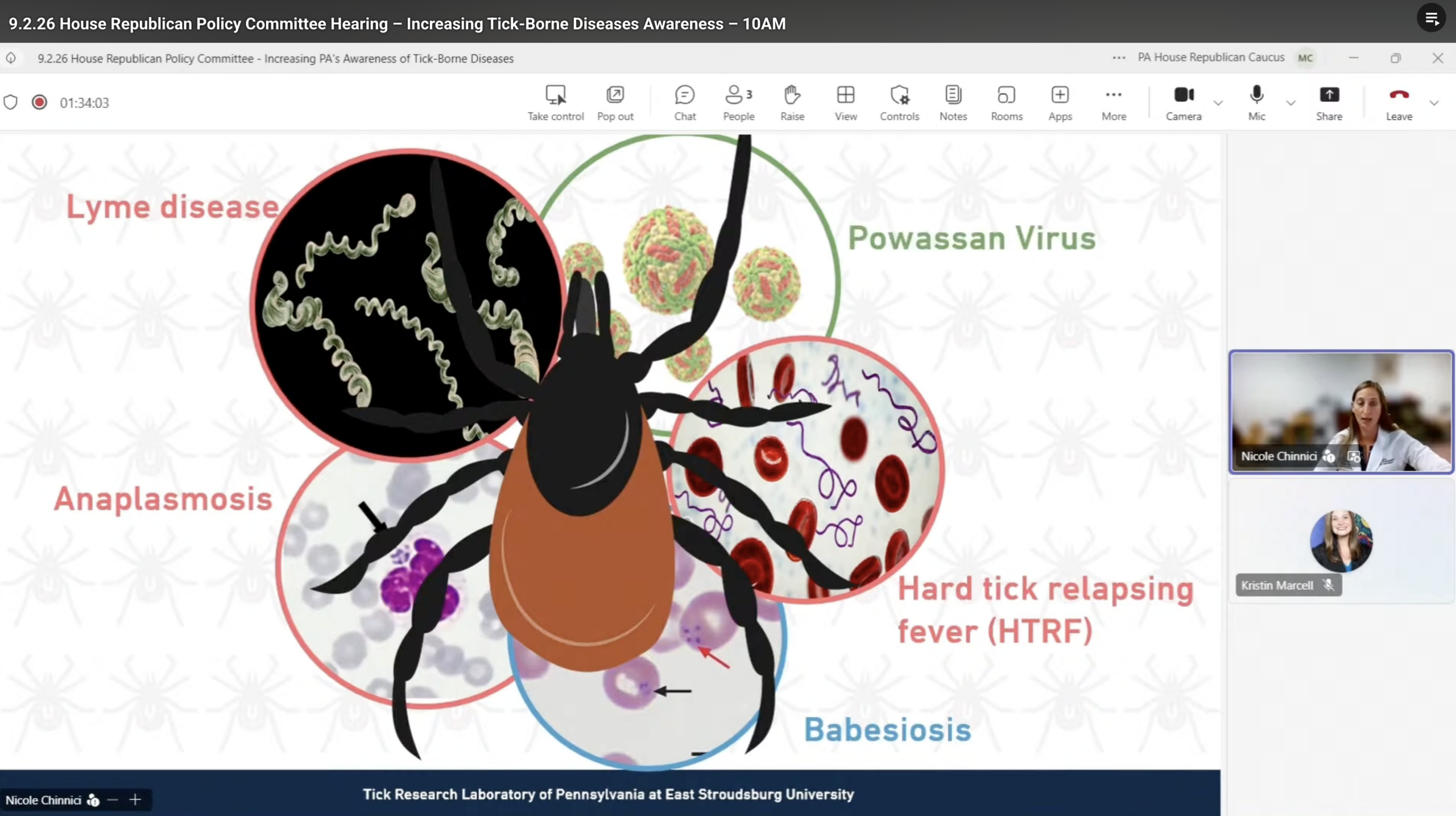
Nicole Chinnici, who directs the Tick Research Lab of Pennsylvania at East Stroudsburg University, said 42 percent of tick bites reported to her lab happened in the person’s own backyard, and that children under 10 are the most commonly bitten group.
Submissions rose, she said, after Act 120 of 2024, effective that December, required schools to preserve ticks pulled off students and tell parents about free testing.
Kami Noel said her 10-year-old daughter came downstairs five years ago and told her, “Mommy, I can’t put my ChapStick on. My smile won’t work.” A pediatrician ordered a Lyme test. Her daughter, now 15, still has flare-ups, joint pain, and fatigue, Noel said.
Rebecca Spielman, a former York College of Pennsylvania professor, said her positive babesiosis results were deleted when her doctors’ paper records were digitized, with no requirement to preserve them elsewhere. She said she was later misdiagnosed with multiple sclerosis, rheumatoid arthritis, and Parkinson’s.
“As an educator, I believe you cannot blame people for not knowing something if it has never been taught to them,” Spielman said of her physicians.