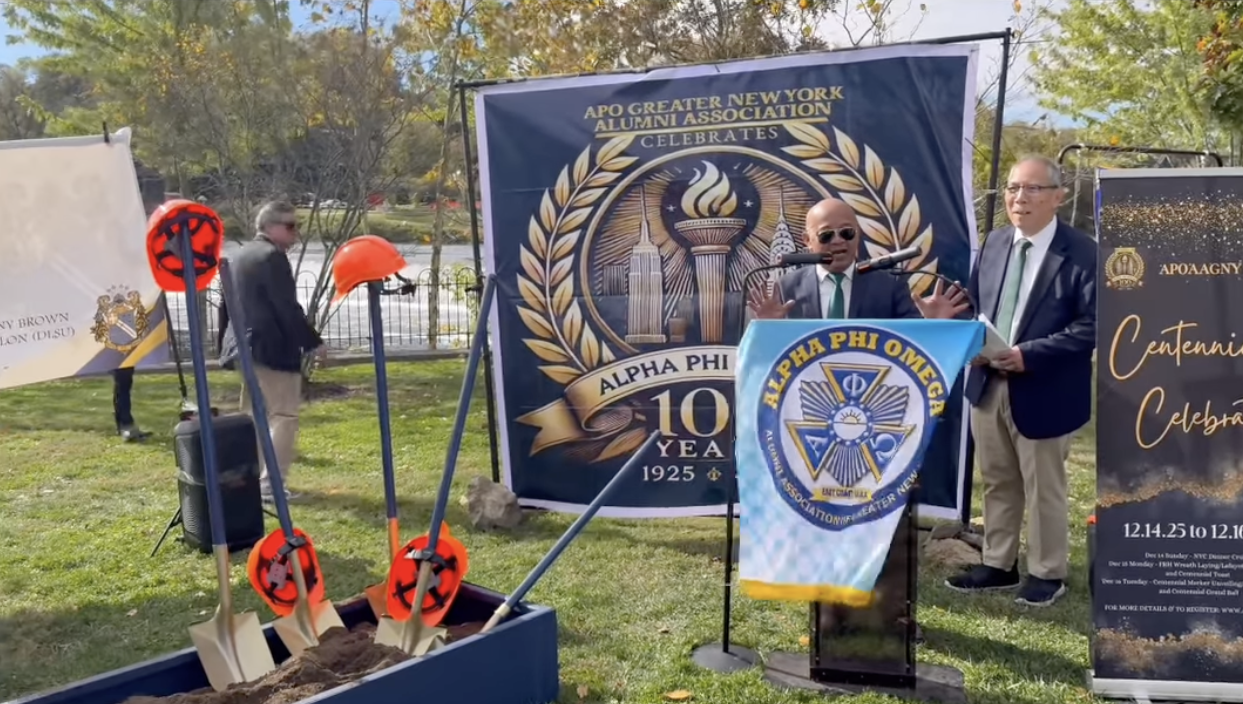
EASTON, Pa. — Easton City Council voted on January 14th to withdraw its support of an obelisk being built in Scott Park. The monument would commemorate Alpha Phi Omega, an international service fraternity founded at Lafayette College, which is celebrating its 100th anniversary since its founding in 1925.
The fraternity is the largest collegiate fraternity in the United States, boasting over 500,000 alumni across more than 780 campuses.
Easton Mayor Salvatore J. Panto Jr. participated in an Alpha Phi Omega Day event on December 16, 2025, which concluded a three-day Centennial program. Alpha Phi Omega alumni from 10 states and 4 countries attended, as the mayor read a proclamation recognizing the fraternity.

However, all City Council members except Panto voted on the 14th to adopt a recommendation from Easton’s Historic District Commission to deny the obelisk’s standing in Scott Park.
The movement was pushed by Councilwoman Julie Zando-Dennis, who agreed with the Commission that the monument’s physical attributes might not be in the city’s best interest. The monument would reportedly be 15 feet tall, looming over public Scott Park.
“The scale and mass is inappropriate,” she said. She added that she also disagreed with the proposed material. “It’s shiny black marble polish, and I think that nowhere else in the historic district are you going to see anywhere polished black marble. It’s usually a marble that you see in cemeteries.”
Easton City Council originally unanimously approved the obelisk 7-0, leading to the groundbreaking ceremony. Councilwoman Zando-Dennis was not on the Council when the obelisk was originally voted on. However, following the HDC’s movement to deny, the Council reassessed its position.
“I didn’t know the size,” Councilman Frank Pintabone said. “I dropped the ball.”
Mayor Panto argued that the fraternity had earned a special status for the city of Easton. Panto also recently took some members from Alpha Phi Omega on a personal tour of the city.
“Alpha Phi Omega is the largest service fraternity in the world,” Panto said. “We should be promoting the fact that we are the home of Alpha Phi Omega.”
Brett Webber, an architect based in Easton, used public comment to thank the Council for taking the HDC’s direction. He argued that building the obelisk would just be another case of private enterprise cluttering the city of Easton.
“There’s a lot of private taking of public space,” Webber said. “These little things over time really erode the character of the city. I applaud the fraternity’s relationship with Easton, but the proposal of a monument that predominates the identity of a city park is a negative thing.”
Councilwoman Zando-Dennis expressed concern that accepting the obelisk would set a precedent for other organizations to place monuments in public parks. Mayor Panto argued, though, that precedent has already been established.
“We’ve given the Rotary Club, we’ve given the Lenni Lenape tribe, I was just following the examples that were given to me before,” he said. “We have more service clubs than we have 100-year fraternities.”
However, Councilman Pintabone also sided with Webber, urging the Council to clearly define its goals for the city’s public spaces. The city voted before the end of 2025 to include a city planner in the final budget, spearheaded by Pintabone.
“What parks are off limits and not?” Pintabone said. “What will we accept and what will we not accept?”
Webber echoed these concerns.
“How do we incorporate these things in a way that doesn’t dominate public space?” he said. “There is a reason and rationale for city government to say that we don’t condone or approve these monuments to predominate over others.”
This discussion comes as Easton residents have pushed back against a proposed million-square-foot warehouse on Wood Avenue, which the city would share with Wilson.
Easton’s planning commission rejected the development plan, chiefly citing that Scannell Properties, the warehouse’s developer, had inadequately addressed how the warehouse would impact traffic. However, residents feel the city isn’t pushing back enough.
“We’re not trying to bring a huge corporation to court,” said Colleen O’Neal, a West Ward resident, in reference to Scannell. “But we are trying to protect ourselves in a way that the city is not going to be able to.”
Easton Solicitor Joel Scheer has expressed that the city’s discretion is limited to their “province of ordinance”, and that Easton might not have reasonable grounds for opposition in the first place. Residents such as O’Neal, however, remain worried about the potential message.
“I think that when any public official voted into office turns to the people that they’re meant to represent and tells them that there is an absolute ‘no’ for something that’s incredibly important to their health and wellbeing, then maybe they need to reconsider how they’re approaching the situation,” O’Neal said.
The city appears to be facing these same concerns with the Alpha Phi Omega obelisk.
“I really have a concern that we are not focusing on the overreach of private developers,” Webber said. “The city has, in my perception, not really been able to organize with private developers. I feel like we’re living in the Middle Ages. We’re basically seeding the public away, and it’s a concern for safety.”
Webber urged the city to address these issues with an eye toward the public good.
“The city should have conviction to enforce the public way.”